AREA OF WORK
Anxiety and anxiety disorders
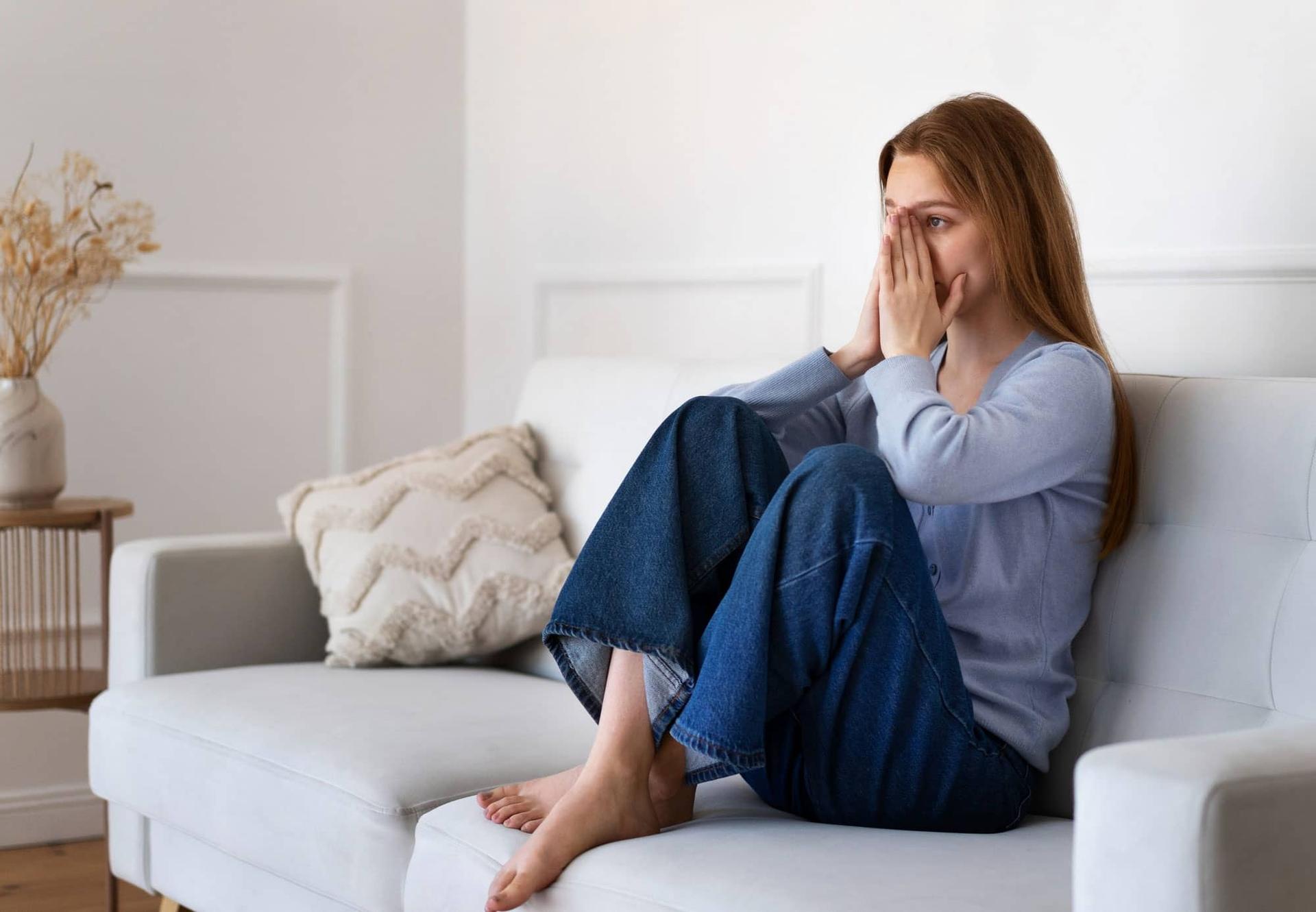
When worry stops being occasional and starts deciding what you do, where you go, and what you avoid.
- Length
- 45 minutes
- Format
- In person and online
- Languages
- English and Italian
- Where
- Milan, Monza, Cernusco sul Naviglio
Does this sound familiar?
Phrases I hear often in practice. Recognising yourself in one of them doesn't mean you have a disorder.
I can't stop worrying, even when I know I'm overdoing it.
My heart was pounding, I couldn't breathe, and I was afraid I was about to die.
It's not the panic attack I'm afraid of. It's the next one.
I'm afraid of feeling unwell far from home.
The moment the metro doors or the aircraft doors close, I feel like there's no air. It isn't the enclosed space. It's the idea of feeling unwell and not being able to leave.
I avoid people so I won't feel judged, and I'm afraid of embarrassing myself even in ordinary situations.
Anxiety disorders, one by one
- Generalised anxiety
- Panic attack
- Panic disorder
- Agoraphobia
- Claustrophobia
- Social anxiety
- Health anxiety
- Hypochondria
- Anticipatory anxiety
- Performance anxiety
- Separation anxiety
- Emetophobia
- Anxiety-related insomnia
- Performance anxiety
- Anxiety in relationships
- Sexual performance anxiety
What anxiety is
Anxiety isn't a flaw. It's a function.
Its job is to anticipate: it prepares the body and mind for something that might happen. The heart speeds up, the muscles tighten, attention narrows to what matters. It's an old system, and when it works as it should it's useful — it's what makes you check twice before crossing, or prepare properly for an interview.
The problem isn't anxiety. The problem is when it stays switched on with nothing to defend against, and when it starts narrowing what you do.
The difference between ordinary anxiety and an anxiety disorder isn't the intensity of what you feel. It's three other things: how long it lasts, how much of the day it occupies, and how many things you've stopped doing in order not to feel it.
Someone can live for years with a high level of anxiety without thinking of it as a problem, simply because they've organised their life around it: avoiding certain places, postponing certain decisions, taking the longer route. The anxiety hasn't decreased. It has just been given room.
How it shows up
Anxiety appears on three levels at once, and often only one of them gets noticed.
In the body. Muscle tension, especially the neck, shoulders and jaw. Difficulty breathing deeply. A racing heart. Digestive problems. Sweating. Dizziness or light-headedness. Trouble falling asleep, or waking in the night. Tiredness that rest doesn't fix.
Many people come to see me after medical tests that found nothing. That doesn't mean the symptoms weren't there: it means the body was responding to something that wasn't an illness.
In thought. Worries that keep returning even when you know they're out of proportion. Anticipation: the mind builds the worst-case scenario before anything has happened. Difficulty concentrating, because part of your attention is always somewhere else. A need for reassurance that works briefly and then has to be renewed.
In behaviour. Avoidance is the most reliable signal. Not taking the motorway, not going to that dinner, not applying for that role, checking your phone, checking your body, asking for reassurance. Every avoidance reduces the anxiety in the moment — which is exactly why it repeats.
Why anxiety keeps itself going
There's a mechanism I recognise almost every time, in different forms.
A sensation gets read as a signal of danger. The body responds as though the danger were real. That response — the racing heart, the short breath — then becomes the evidence that the danger was there.
Then comes avoidance, and with avoidance comes relief. The relief is immediate and concrete, and it teaches something specific: I avoided it, and nothing happened. But the conclusion the brain draws isn't "there was no danger." It's "I was right to avoid it."
So the field narrows. Not through a decision, but through a series of small reasonable choices made one at a time.
The same applies to control. Checking your body, your symptoms, your messages, your test results: each check lowers the anxiety for a few minutes and raises it again straight after, because one verification calls for the next.
There is no single cause of anxiety disorders. Individual predisposition matters, personal history matters, prolonged periods of stress matter, and so does the way you learned to read your body's signals. But how anxiety sustains itself is usually more accessible than where it came from — and that's where the work can start.
Anxiety and moving country
A large part of the people I see in English didn't grow up in Italy.
Relocation puts pressure on the things that usually hold anxiety in check. The support network is somewhere else, often in another time zone. Ordinary tasks — a doctor's appointment, a bank, a lease — take more effort in a second language. Work identity may have shifted. And the people who would normally notice that something is wrong aren't in the room.
This shows up in a few recognisable ways: anxiety that started after the move and was put down to adjustment; a partner's family becoming the entire social world; the sense that going home would be an admission of failure; symptoms that appear physical and get investigated medically for months.
None of this makes anxiety different in kind. But it changes what maintains it, and that's worth naming rather than working around.
How I work with anxiety
The first session is about understanding what we're dealing with. It isn't a test and it isn't a commitment to continue: it's a conversation in which you tell me what happens, how long it's been going on, and what you've already tried.
From there the work runs on two tracks.
The first is understanding the mechanism — not anxiety in general, but yours. Which situations set it off, which interpretations feed it, which strategies are keeping it going without your noticing. Many people discover at this stage that what they were doing to manage the anxiety was part of what kept it alive.
The second is working on the concrete situations, gradually and by agreement. It isn't about facing everything you avoid at once, but about rebuilding room where the field had narrowed.
I also work with the body, because in anxiety the body isn't an accessory: it's where the thing happens first.
I studied Cognitive and Clinical Neuroscience at Maastricht University and worked as a researcher on the mechanisms of anxiety and panic before training as a psychotherapist. That's why how the body produces and maintains anxiety is central to how I work.
Working in English, in Italy
I'm an Italian psychologist and psychotherapist, registered with the Order of Psychologists of Lombardy, and I work in both English and Italian.
I see people in person at two practices in Milan, in Monza, and in Cernusco sul Naviglio, and online across Italy and beyond. Working in English isn't an accommodation here: I studied and worked abroad, and a real part of my practice has always been with people who moved to Milan from elsewhere — expats, people who relocated for work, partners of Italians, students, people who arrived for a year and stayed.
If Italian isn't the language you'd choose to describe what's happening to you, that matters. Anxiety is hard enough to put into words in your own language.
When it makes sense to ask for help
There's no threshold of severity you have to cross before you're allowed to ask.
The more useful questions aren't "is it bad enough?" but:
— How many things have I stopped doing in order not to feel anxious?
— How long has this been going on?
— Have the people close to me noticed?
— How much of my day goes into managing it?
If any of those makes you uncomfortable to answer, that's reason enough to talk about it. You don't need to wait for it to get worse, and you don't need to have worked out what to say: the first session exists partly for that.
Frequently asked questions
It's a 45-minute meeting where you tell me what's going on. It's there to understand what you're asking for and to work out together whether and how to continue. It doesn't commit you to carrying on.
Because it's already clinical work, not a sales meeting. The time, the listening and the assessment are the same as in any other session.
Yes. Online sessions run the same length and cost the same as those in person. For some people it's what makes starting possible at all — for instance when anxiety makes travelling difficult, or when you're not in Milan.
I'm not a medical doctor and I don't prescribe. Psychotherapy can be done with or without medication; where medication is already in place, or where it emerges that it might be worth considering, I work alongside your GP or psychiatrist.
Medical assessment comes first. If you haven't had one, that's the first step. Many symptoms of anxiety are physical, and telling them apart takes a medical examination, not a psychological interpretation.
No. Arriving without knowing where to start is common. I'll ask the questions.



Dr. Giuseppe Iannone — Psychotherapist
FIRST STEP